
Breaking the Fed Put: How Warsh Is Rebuilding Market Expectations

Updated: Sep 9
From Thatcher and Truss to the Chinese government: why a new regime must create the conditions for sustained action
“And we can be held accountable for delivering on our remit—the only true test of our credibility.” — Kevin Warsh, Jackson Hole, August 28, 2026
Credibility Is Built Not by What Is Said, but by What Is Ultimately Delivered.
The new regime Warsh wants to establish is actually quite clear: shrink the Fed Put. Ordinary market volatility, asset-price adjustments, and non-systemic losses should once again be left to the market; the Federal Reserve should intervene only when core functions such as trading, financing, and payments fail. The real difficulty is not announcing this boundary, but making the market believe it through repeated episodes of volatility.
This creates a paradox. The new regime must establish credibility by consistently refusing to backstop non-systemic market volatility. Yet if the signal is too strong or the transition too fast, the market may form a one-way consensus trade, and leveraged liquidations and forced selling could turn ordinary volatility into a systemic crisis. If the Fed is then forced into a broad rescue, the market will draw the opposite conclusion: the old Fed Put still exists. Warsh therefore needs to allow greater uncertainty in the policy path and larger asset-price swings without letting volatility cross the boundary into systemic dysfunction.
Success for the new regime does not mean eliminating market volatility, nor does it mean smashing old expectations through one major crisis. It means making the market absorb price losses and tail risk while keeping the core system stable, then proving through sustained action that the boundary of the Fed Put has narrowed.
Warsh’s performance so far suggests that his objective is clear, but he has not locked himself into a specific route, pace, or magnitude, and he is avoiding signals so strong that they manufacture a crisis the Fed would be forced to rescue. This is a steadier transition path and one more likely to succeed. The investment conclusion is therefore two-sided: a major crisis should not be the base case; but precisely because the new regime may succeed, assets should already be repriced for a transfer of tail risk from the Fed to the market. As forward guidance declines and the Fed Put contracts, term premia, credit spreads, and compensation for liquidity and leverage risk should all rise. Assets most dependent on low volatility, cheap financing, and central-bank support will be affected most.
Thatcher, Truss, and China’s property adjustment illustrate three different outcomes: how to create the conditions for sustained action, how to destroy those conditions at the outset, and how controlling risk can buy time for expectations to reset.
I. Thatcher: First Build the Capacity to Withstand the Test
After World War II, Britain operated for decades under the so-called postwar consensus. The government used fiscal and monetary policy to lean against the economic cycle: it tightened when growth and the balance of payments deteriorated, then returned to stimulus as unemployment rose. Policy repeatedly moved in “stop-go” cycles, and unions, companies, and the government gradually formed a shared expectation: the government might be tough temporarily, but it would ultimately be unable to bear the political cost of unemployment and strikes and would reverse course.

Chart: The mechanism and growth outcomes of Britain’s old “stop-go” regime
The core problem in this mechanism was not any particular interest-rate level, but the government’s lack of credibility.
That is what Thatcher changed. After taking office in 1979, she first raised interest rates and value-added tax; in 1981, she tightened fiscal policy again amid a severe recession. A group of 364 economists signed a letter opposing the policy, yet she did not change direction.
The more difficult test came from the National Union of Mineworkers. Miners controlled a critical node in Britain’s energy supply, and strikes in 1972 and 1974 had severely disrupted electricity and industrial production. In 1974, Edward Heath’s government called an early election amid the Three-Day Week and its confrontation with the miners, then lost power. This left a powerful political memory: the miners’ union could do more than negotiate wages; it could force a government to change policy or even remove it from office.
In 1984, a strike began after the National Coal Board announced capacity reductions equivalent to 20 pits, affecting roughly 20,000 jobs. At the peak, about 142,000 miners participated. Places such as Orgreave saw violent clashes between pickets and police, while mining families and communities bore enormous economic and social costs. The government was not improvising: it had stockpiled and imported coal, coordinated police forces across regions, and worked to maintain the electricity supply. On the other side, the union did not hold a nationwide membership ballot; miners in Nottinghamshire and elsewhere continued working, and divisions emerged within the strike.
For Thatcher, this confrontation tested more than coal policy; it tested who would set the rules. If the government retreated, the history of 1974 would repeat itself, once again validating the old expectation that “the government will always back down in the end.” The strike continued for nearly a year, until miners returned to work in March 1985 without a national agreement. The government paid an enormous political and social price, but it also proved to unions, companies, and markets that it would no longer return automatically to the old rules merely to avoid short-term pain.
Once that threat became credible, the mechanism by which expectations formed changed. Unions began to consider low-inflation constraints when making wage demands, while companies had to believe the government’s objective when signing contracts and setting prices. Policy was no longer pulled along by markets and unions; instead, markets began adapting to the new framework set by the government.
Thatcher’s Critical Move Was Not Simply to Be “More Hawkish,” but to Change the Policy Reaction Function: The Government Would No Longer Be Forced to Retreat by Old Expectations.
Credibility, however, is not a substitute for structural reform. It is the prerequisite for structural reform to be believed, implemented, and sustained. If the government retreats at the first increase in unemployment, strike, or market pressure, even the best reform will be treated as temporary policy, and economic actors will not change their long-term behavior in response.
Thatcher first used monetary and fiscal anchors, together with refusal to retreat in key confrontations, to build the capacity to bear the cost of reform. She did not begin by increasing government borrowing to fill a revenue gap created by tax cuts. The largest reductions in income and corporate taxes came mainly after inflation had fallen and the fiscal foundation had improved, while value-added tax, social-insurance contributions, and North Sea oil and gas revenue provided partial offsets. These conditions meant that the government did not have to retreat at the first resistance to reform.
On this foundation, structural reforms gradually embedded the new regime in institutions. Privatization brought large state-owned enterprises to the capital markets. Housing reform sold council homes through the Right to Buy and expanded the class of homeowners. Financial liberalization, symbolized by the 1986 “Big Bang,” reshaped London’s financial markets. Labor-market reform tightened union powers through successive legislation and broke the unions’ de facto veto over policy in the miners’ confrontation.
These reforms changed asset ownership, market incentives, and the structure of political power, while also raising the cost of reversing the new framework. Credibility persuaded people that reform would not be easily withdrawn; structural reform, in turn, increased the government’s capacity to continue upholding the new rules.
In terms of outcomes, British inflation and strike activity declined markedly during the 1980s, while privatization, expanding homeownership, and financial liberalization reshaped the economic structure. Even after subsequent changes in governing party, the core framework of market-oriented reform was not reversed wholesale.
The costs were equally severe: the early recession and high unemployment accelerated the contraction of traditional industries; mining communities and others suffered lasting trauma; and regional disparities and income inequality widened.
Credibility Opened Space for Reform, and Structural Reform Institutionalized the New Regime; Each Reinforced the Other.
II. Truss: Damaging Her Own Conditions for Implementation from the Outset
Liz Truss was the shortest-serving prime minister in British history. After taking office in September 2022, her aggressive fiscal program quickly triggered turmoil in sterling, government bonds, and pension markets. She resigned under pressure from her own party after only 49 days in office.

Figure: Photographs of Thatcher and Truss on tanks were juxtaposed in the media. Image sources: Associated Press, Simon Dawson, and the UK Prime Minister’s Office.
Yet she did not take office looking like someone “destined to fail.” Truss’s political positioning readily evoked Thatcher: she emphasized free markets, individual responsibility, and political will, and hoped to lead Britain out of stagnation through supply-side reform. A photograph of Truss wearing a helmet atop a tank before becoming prime minister was widely placed beside Thatcher’s famous tank image, making the association with a “new Iron Lady” visually immediate.
The comparison was not merely image politics. Britain in 1979 and 2022 operated in very different economic environments, but both faced high inflation, weak growth, and dissatisfaction with the existing policy framework. The Truss government believed that high taxes, regulatory and planning constraints, inadequate investment, and weak productivity had weighed on Britain’s long-term growth. The Growth Plan 2022 targeted trend growth of 2.5%, proposed cuts to personal and corporate taxes, regulatory easing, investment zones, and faster energy and infrastructure projects, and aimed to drive growth through private investment and higher productivity.
The starting point was not absurd. The UK government’s own plan noted that average growth over the two decades before the pandemic was only 1.8%, that annual productivity growth had fallen to about 0.4% after the financial crisis, and that Britain’s investment rate was below the OECD average. If reform could raise investment and productivity, faster growth could indeed expand the tax base and ease fiscal constraints.
The problem was not her desire to restart growth, but her mistake of treating a “Thatcherite direction” as a policy package that could be copied immediately—and reversing the sequence in which credibility must be built.
Instead of first strengthening the government’s capacity to withstand a market test, she weakened the fiscal anchor, institutional endorsement, and policy coordination at the same time. As a result, the faster reform advanced, the worse the conditions became for continuing it.
UK inflation was close to 10% in 2022, and the Bank of England was raising rates and preparing quantitative tightening. The Truss government nevertheless began with roughly £45 billion of tax cuts and assumed the cost of a vast energy subsidy without explaining what additional revenue or spending reductions would fill the gap. It also bypassed the independent forecast of the Office for Budget Responsibility and removed the Treasury’s most senior civil servant.
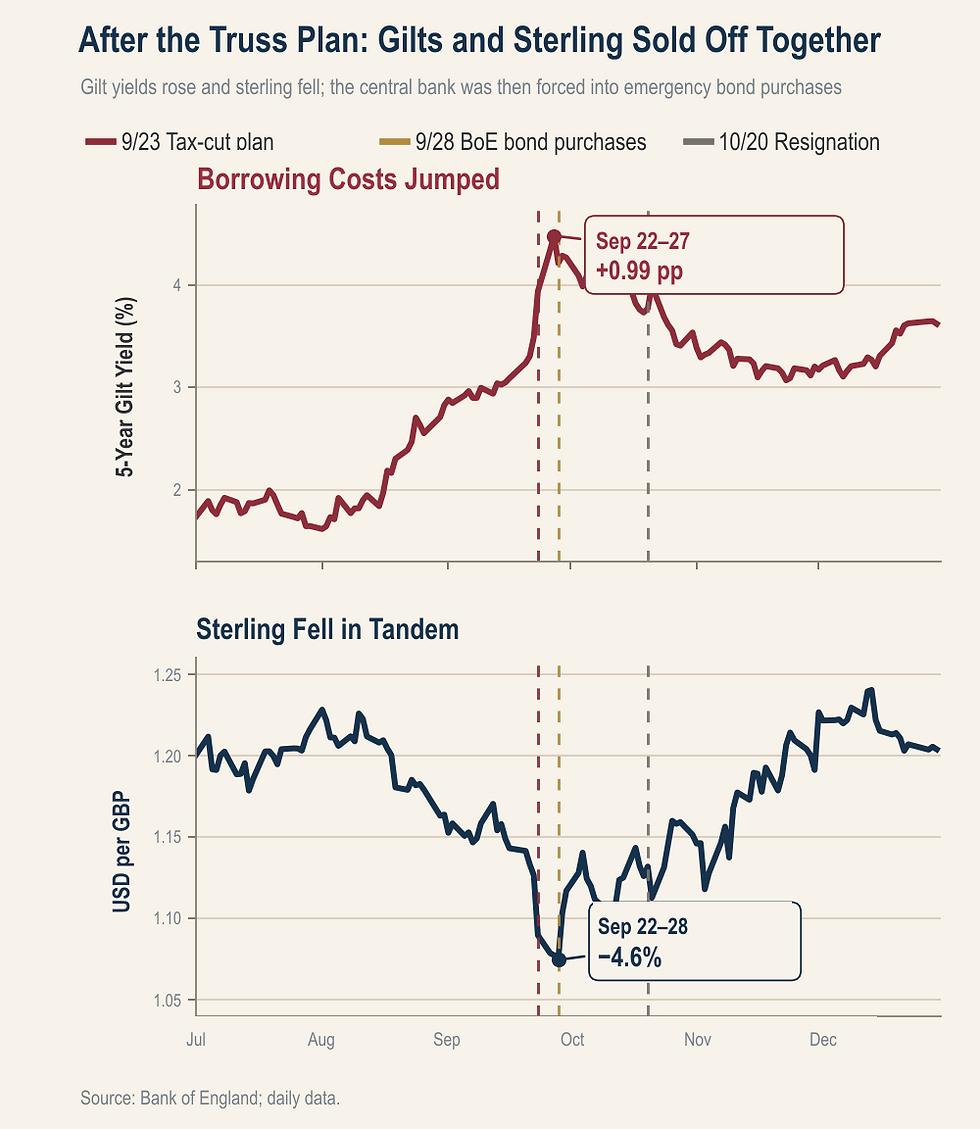
Chart: After the Truss plan was announced, five-year UK government-bond yields surged as sterling fell. Data source: Bank of England.
The market did not infer that “Britain will grow faster.” It inferred a different chain:
Fiscal expansion → Greater government-bond supply and higher inflation expectations → Higher interest rates → A heavier government interest burden → The need for more borrowing or monetary easing.
The initial rise in government-bond yields was merely a repricing. But liability-driven investment (LDI) strategies were used on a large scale in Britain’s pension system and employed leverage, so the shift in yields quickly triggered margin calls. Pension funds were forced to sell government bonds; falling bond prices then generated further margin pressure. A linear adjustment became a self-reinforcing fire.
The Bank of England was ultimately forced to make temporary purchases of long-dated government bonds to restore market functioning. This gave the crisis the dangerous appearance of “fiscal dominance”: fiscal decisions had pushed the central bank into a conflict between monetary tightening and financial stability.
Truss failed not because the market opposed reform, but because reform—without a fiscal anchor, institutional coordination, or balance-sheet buffers—gave everyone a reason to make the same directional trade.
This is the most direct warning for Warsh. The more abruptly new rules are announced, the more likely the market is to form a one-way consensus bet. If leverage and maturity mismatches are hidden inside the financial system, an ordinary repricing can cross the boundary into systemic dysfunction. At that point, the central bank is forced to rescue the market, thereby proving that the old “Fed Put” still exists.
III. China’s Property Sector: Control the Situation and Buy Time for Action
China’s property sector offers another form of regime transition.
After the 1998 housing reform, home prices rose for a long period, local-government finances came to depend on land sales, and property became linked to construction, building materials, home appliances, automobiles, and household wealth. During downturns including the 2008 global financial crisis, the government repeatedly used credit, fiscal, and property policies to stabilize the market. Decades of repeated action gradually created a powerful belief: property affected too much of the economy for the government not to backstop it eventually.
Beginning in 2020, some smaller regional developers and developers with unusual business models that were regarded as non-systemic encountered debt problems, which the market could readily interpret as isolated cases. When Evergrande’s risk surfaced, the market found another explanation: Evergrande was a “problem child” that had expanded recklessly, and refusing to rescue it would avoid creating a bad precedent. In December 2021, the China Securities Regulatory Commission likewise characterized Evergrande as an isolated risk caused by “poor management and blind diversification and expansion.”
After that, however, it became difficult to argue that the problem consisted only of isolated cases. Nationally known private developers including Kaisa, Sunac, Shimao, and Country Garden defaulted in public markets or entered debt restructuring. Among the formerly leading private developers, companies such as Longfor that continued to service debt normally became the exception. They might receive project-level support, maturity extensions, or coordinated financing, but the government did not restore their corporate credit, nor did it guarantee full payment to shareholders and bondholders.
Once mixed-ownership Vanke also entered a period of liquidity pressure, it became even harder for the market to explain everything in terms of “bad companies.” Vanke received tens of billions of renminbi in shareholder loans and other support from its largest shareholder, Shenzhen Metro. Yet this support came with explicit shareholder responsibility, collateral, and repayment arrangements; it did not amount to a central-government guarantee that every developer, shareholder, and bondholder would emerge whole.
To say that there was “no rescue” means, more precisely, that the original credit and business models of developers were not rescued. The government protected projects, delivery, and the system, but no longer promised to protect companies, shareholders, or bond investors.
The government did not face a simple choice between “rescue” and “no rescue,” but two choices that could each defeat their own purpose.
If the government rescued developers through broad credit easing and implicit guarantees as it had in the past, it could stabilize the market in the short term, but would once again prove that “property will always be backstopped in the end,” immediately undermining deleveraging and the effort to break implicit guarantees. Yet if the government began with an exceptionally clear and forceful “no rescue” signal, local governments, banks, households, developers, and bond investors might all move in the same direction at once: households would stop buying homes, banks would contract credit, investors would sell property bonds en masse, and developers would accelerate asset sales and construction cutbacks.
That would compress losses that could otherwise be absorbed over time into the same moment: more households that had purchased homes would fail to receive them, banks would have to recognize bad debts simultaneously, and developer defaults and property-bond defaults would occur simultaneously. More dangerously, it would trigger a negative feedback loop among property, local-government finances, and local-government debt. Land-sale revenue would plunge; the value of land and property collateral would fall; and the refinancing capacity of local-government financing vehicles would weaken. With local governments already dependent on land revenue and burdened by both explicit debt and financing-vehicle debt, debt service, home-delivery guarantees, and basic public services would compete for limited funds. If the crisis crossed the boundary into systemic risk, the government would instead be forced to intervene broadly again. The market would then conclude that “the government will rescue the sector in the end,” destroying the new regime’s credibility through its own actions.
China in practice followed a third path: the ultimate boundary became gradually clearer, but the specific route, pace, and allocation of losses were not fixed once and for all. Official language often pursued several objectives simultaneously: deleveraging while stabilizing growth; market-based resolution while preventing systemic risk; recognizing property’s role as a pillar while not restoring blanket guarantees for developers.
This ambiguity in the path prevented local governments, financial institutions, households, developers, and property-bond investors from synchronizing their trades around a single definite policy signal. Local governments might protect projects without protecting companies; banks might extend selected loans rather than roll over all credit; households would distinguish among cities, developers, and projects; and bond investors would form different estimates of recovery rates. Decisions were distributed across actors. Their disagreement delayed a coordinated retreat and spread the costs of adjustment across different periods and different balance sheets.
Compared with the relatively ambiguous language, the boundary revealed by action was more stable: developers were allowed to default, leaving shareholders, offshore creditors, and the old business model to absorb losses, while government resources were concentrated on ensuring home delivery, protecting buyers, and financing projects. City-level property-financing coordination mechanisms supported construction and delivery through project-specific “white lists,” rather than restoring developers’ former implicit guarantees.
A new boundary formed:
Developers, shareholders, and bond investors are not guaranteed protection from losses, but the authorities seek to ensure delivery of presold homes, protect homebuyers’ basic rights, and prevent disorderly contagion through the financial system.
The lesson from China’s property adjustment is not that ambiguity is inherently superior. It is that in a fragile environment, an excessively strong signal should not be allowed to trigger synchronized action. Keeping the transition path open while gradually proving the new boundary through sustainable action can be more effective.
This transition is, of course, far from complete. Property prices, sales, local-government finances, and household confidence are still adjusting, and the “new model” has not yet been fully established. A more precise description is that China has partially broken the old expectation of a blanket property rescue, while a new equilibrium is still forming.
IV. What New Regime Does Warsh Want to Establish?
Taken together, the three cases show that Warsh wants to change more than the Federal Reserve’s communication style. He wants to change the relationship between the Fed and the market—who follows whom.
Over the past decade and more, markets have grown accustomed to a stable feedback mechanism: when financial conditions tighten and asset prices fall rapidly, the market begins betting that the Fed will turn dovish; that expectation itself then drives a rebound in asset prices. Over time, the market became increasingly dependent on the Fed, while the Fed became increasingly dependent on market prices that it had itself shaped. Warsh calls this the “hall-of-mirrors problem”: the market repeats the central bank, and the central bank then reads information from the market’s echo.
The new regime he wants is clear: the Fed should focus on inflation, employment, and the proper functioning of the financial system; ordinary market volatility and asset valuation should return to the market; and unconventional tools should be reserved for genuine crises, not every decline in prices.
Thatcher — Old expectation to change: the government would eventually yield under pressure from unions, inflation, and short-term unemployment. Method for building credibility: first absorb the costs of tightening and political conflict, then advance structural reform. Main outcome or risk: the new regime was established, but at high cost and with dependence on fiscal and political conditions. Truss — Old expectation to change: low taxes and small government could quickly restart growth. Method for building credibility: launch large tax cuts at once without arranging additional revenue or other spending reductions to fill the gap. Main outcome or risk: one-way repricing combined with leverage triggered a fiscal and financial crisis. China’s property sector — Old expectation to change: the government would ultimately provide a blanket backstop for home prices and developers. Method for building credibility: decline to provide a blanket rescue while selectively protecting delivery and system functions. Main outcome or risk: the old guarantee was partially broken, but the adjustment is prolonged and the new equilibrium remains unsettled. Warsh — Old expectation to change: market volatility would eventually bring a dovish Fed turn or a rescue. Method for building credibility: clarify objectives and boundaries, reduce forward guidance, and let the market price risk itself. Main outcome or risk: whether this can survive the first true episode of market stress remains untested.
At his first press conference in June 2026, Warsh removed forward guidance from the policy statement and declined to submit his own dot-plot projections. He was exceptionally clear about the 2% inflation target, yet refused to say what action the next meeting would take.
At his second press conference in July, the approach became more concrete. He said the Fed would not “spoon-feed the market,” preview decisions, or provide hints. Markets should form their own judgments from actual economic information. He even welcomed adjustments in yields without Fed action because they restored unpolluted price signals to the central bank.
On August 28, his 100th day in office, Warsh formalized the theory in his Jackson Hole speech: forward guidance should be limited in normal times; short-term interest rates should be the primary tool; unconventional policy should be used only in genuine crises; the Fed should communicate more quietly and purposefully; and market participants should not rely primarily on the Fed to identify their next trade.
The central ideas were highly consistent across all three stages:
Transparent objectives. The 2% PCE inflation target is fixed, while employment and price stability are statutory responsibilities. A hierarchy of tools. Short-term interest rates are the conventional tool; unconventional balance-sheet policies are reserved for genuine crises. The market resumes responsibility for pricing. Market participants should form decentralized judgments based on growth, inflation, fiscal policy, credit, and liquidity. No advance commitment to the path. The Fed does not commit to a specific rate path, timing, or magnitude, nor does it allow the dot plot to become a quasi-policy commitment.
This is not informational opacity. What Warsh actually opposes is turning “transparency” into a quasi-commitment about future policy. His goal is to be transparent about principles without committing to the path; clear about responsibilities while preserving choice at every decision.
V. The Greatest Constraint: Debt Needs Time, and Dollar Credibility Cannot Be Overdrawn
Warsh inherited a highly constrained starting point. High debt and dollar hegemony are not two separate problems, but opposite sides of the same US balance sheet. The United States needs the world to keep buying dollar assets to absorb its enormous debt; the world’s willingness to keep buying depends in turn on the United States not abusing fiscal and monetary credibility.
The First Constraint: High Debt Requires Time.
According to the Congressional Budget Office’s 2026 baseline projection, federal debt stands at roughly 101% of GDP; the 2026 deficit is about $1.9 trillion, or 5.8% of GDP; and net interest expense already exceeds $1 trillion. At the same time, roughly $4.5 trillion of mandatory spending is constrained by law, demographics, and politics and cannot be reduced quickly.
The fiscal arithmetic is straightforward. Debt issued during the low-rate period matures and is refinanced at higher rates. By 2036, revenue as a share of GDP is projected to rise only from 17.5% to 17.8%, while net interest expense rises from 3.3% to 4.6%. When revenue cannot keep pace with interest, the government can only issue more debt; additional issuance then raises future interest costs, creating a “debt–interest–deficit–more debt” cycle.
Growth offers a way out, but it takes years. Higher productivity can expand the economic and tax base and gradually reduce the debt ratio. During that period, the United States must first prevent the financing environment from becoming disorderly. Warsh therefore cannot prove himself through a sudden and absolute declaration of “no intervention.” If long-term rates and term premia surge, debt-service costs and deficits will worsen as borrowing requirements rise, potentially disrupting the Treasury market and ultimately forcing the Fed into a large-scale rescue.
The Second Constraint: Dollar Credibility Cannot Be Overdrawn.
Although the dollar’s share of global reserves has declined gradually over the past two decades, it still stood at 57.13% in the first quarter of 2026, leaving its dominant position intact. More important than the percentage itself is the funding loop created by dollar hegemony.
Producing and exporting countries provide real goods and services and receive dollars. Dollars not used to purchase US goods then return to US assets in the form of deposits, Treasury securities, corporate securities, and other instruments. Dollar savings in trade-surplus countries supplement domestic US savings, providing cheaper financing to the US government, companies, and households and supporting investment and consumption. As of the first quarter of 2025, foreign investors held about $9 trillion of tradable US Treasury securities, or roughly 32% of the total.
This privilege becomes even more important in a crisis. Global trade and debt are extensively denominated in dollars. When private financing markets freeze, the world competes for dollars at the same time. Capital flight, local-currency depreciation, and rising dollar-debt burdens can reinforce one another. The International Monetary Fund notes that sudden capital outflows create financing gaps and amplify the rollover pressure from currency mismatches and dollar debt.
Other central banks can issue their own currencies, but not dollars. For countries with open capital accounts and substantial foreign-currency liabilities, large-scale issuance of local currency may further fuel depreciation, inflation, and capital flight. The United States, by contrast, borrows mainly in its own currency, while the Fed is the ultimate issuer of dollar liquidity and therefore does not first encounter a constraint of “running out of foreign exchange.” In 2008 and 2020, the Fed provided dollars globally through central-bank swap lines, whose peak balances were roughly $585 billion and $450 billion, respectively. The United States not only issues the world’s safe asset; it also controls the ultimate tool for repairing dollar liquidity in a crisis.
Yet this privilege depends precisely on global confidence in the dollar’s purchasing power, the safety of US Treasury securities, and the US institutional system’s refusal to abuse its money-creation capacity. If policy is too dovish, the market will suspect that fiscal costs will ultimately be paid through inflation and the Fed’s balance sheet, slowly eroding dollar credibility. If policy is too aggressive, it may first trigger an accident in the Treasury market and highly leveraged systems, damaging the dollar’s reputation as the global safe asset.
Warsh therefore faces a transition with cliffs on both sides: if he is too dovish, the old regime continues; if he moves too aggressively, the new regime may die in its first financial accident.
VI. Warsh’s Strategy: First Create the Conditions for Sustained Action
In this environment, Warsh’s most important task is not to convince the market as quickly as possible that “the Fed will never rescue it,” but first to create an environment in which the new rules can be executed repeatedly. The new regime’s credibility depends not on the strength of the first statement, but on whether he can continue to hold the same boundary when the next episode of pressure—and the one after that—arrives.
If an excessively strong signal itself triggers a crisis in Treasuries, credit markets, or a highly leveraged financial system, the Fed will be forced to intervene on a large scale. The market will ultimately learn not that the Fed Put has disappeared, but that the Fed will still rescue it if prices fall far enough. The new regime will fail its first test.
Controlling the situation is therefore not retreat, but a way of creating favorable conditions. In his haste to prove the new rules, Warsh cannot first destroy his own capacity to uphold them.
This is also the key to understanding Warsh’s reduction of forward guidance. The destination can be clear—the 2% inflation target, the dual mandate, no rescue for ordinary volatility, intervention only for systemic dysfunction—without handing the market a predetermined route. When to act, by how much, and which market level will trigger a response can all remain matters of judgment.
An open path allows different participants to form different judgments based on growth, inflation, fiscal conditions, and liquidity, reducing the risk that everyone bets on the same policy direction at once. The aim is not to manufacture surprises, but to avoid a Truss-style one-way repricing and let the market learn the new boundary gradually over a longer period.
Refusing to reassure markets during ordinary volatility gradually weakens the Fed Put. When trading functions truly fail, temporary, targeted, and reversible liquidity tools can restore the mechanism. This does not violate the new rule against backstopping market volatility; it prevents the situation from deteriorating until the Fed is forced into a comprehensive market rescue and a wholesale retreat. Every successful defense of the boundary increases the capacity to defend it again.
One point must be emphasized: Warsh has not explicitly said that he is reducing forward guidance to buy time for fiscal adjustment and for preserving dollar credibility. That is our interpretation based on the constraints of the US balance sheet. His public behavior is nevertheless highly consistent with this method: state the objective clearly, say little about the exact route, let the market price risk independently, and preserve the capacity to act in a crisis.
What matters, therefore, is not whether the next move is a rate increase or a rate cut, but the following four tests.
First, can the removal of forward guidance be sustained? The June and July meetings did not restore a commitment to a path. When markets eventually experience major volatility, the first test will be whether the Fed returns to reassuring them through speeches and the dot plot.
Second, how will the boundary between market volatility and market dysfunction be enforced? Falling equities, wider credit spreads, and rising long-term yields do not in themselves constitute systemic failure. Central-bank intervention is warranted when trading functions break down, financing chains fracture, payment and settlement are obstructed, or forced selling creates systemic contagion. Warsh has not yet demonstrated this boundary in a genuine crisis.
Third, can the tools be separated? If the Treasury market suffers a functional failure, the response most consistent with the new framework would be neither an immediate rate cut nor long-term suppression of Treasury yields, but temporary, targeted, and reversible liquidity tools used solely to restore market trading. The Bank of England’s temporary bond purchases during the 2022 liability-driven investment crisis—although forced by the emergency—offer an operational example of “rescuing the mechanism, not the price.”
Fourth, will fiscal policy cooperate? The Fed can narrow its own boundary, but it cannot establish fiscal discipline on behalf of Congress and the government. Without a credible medium-term fiscal path, the more the central bank emphasizes that it will not backstop markets or fiscal policy, the more likely the term premium on Treasury securities is to rise. Warsh can rebuild the rules of monetary policy, but he cannot rebuild the entire US macroeconomic regime alone.
Conclusion: A Quiet Revolution
On the surface, Warsh’s reform is about saying less. In substance, it reallocates responsibility for producing information and bearing risk. At a deeper level, it creates the conditions for sustained implementation of new rules.
Markets no longer wait for the central bank to provide answers; they must judge growth, inflation, fiscal conditions, the dollar, and financial fragility themselves. The Fed is no longer responsible for smoothing every asset-price fluctuation, but must concentrate its credibility on inflation, employment, and system function.
Warsh needs Thatcher-like clarity of objectives and consistency of action, but cannot copy the intensity of Thatcher’s early tightening. He must avoid Truss’s error of creating a one-way trade and a leveraged stampede. In the method of transition, he is instead closer to China’s property adjustment: control the situation, buy time, repeatedly weaken the old guarantee through action, and narrow the scope of protection from asset prices and corporate entities to basic rights and system functions.
A New Regime Is Built Through Sustained Action—and Sustained Action Depends on Preserving the Conditions Needed to Continue.
From an investment perspective, the logic should proceed in this order. First, Warsh is following a sound transition path that may succeed, so a major crisis should not be the base case. He has neither continued the former implicit guarantee against market volatility nor attempted to destroy old expectations at once with a sudden and forceful “no rescue” signal. While clarifying the new boundary, he has preserved flexibility in the route, pace, and magnitude, creating the conditions for sustained implementation. A more reasonable expectation is that uncertainty and market volatility will rise; local adjustments and individual defaults will be allowed; but core trading, financing, and payment systems will remain stable. Second, precisely because the reform may succeed, the market should already incorporate “the transfer of tail risk from the Fed to the market” into pricing. Once the Fed Put’s boundary genuinely narrows, non-systemic price declines will no longer automatically produce policy support. Term premia, credit spreads, and liquidity compensation should rise; highly leveraged, long-duration assets dependent on continual refinancing must bear a larger risk discount. This repricing does not require a major crisis.
The market cannot both judge that Warsh may succeed and continue to price assets under the old Fed Put. Nor should it assume in advance that he will fail and make a major crisis the base case while he has yet to commit a clear policy error and is pursuing a steadier path. What must be priced in ahead of time is the shift in who bears tail risk, not the inevitability of a broad crisis.
If a major crisis does occur and forces the Fed to backstop broad asset prices again, that would instead mean that the transition path had failed: the old Fed Put would be reaffirmed. But this should be a low-probability failure scenario, not the starting point for investment judgment.
Only then will the market know who is following whom.
Information is current as of September 2, 2026. The Truss reform objectives and UK growth, productivity, and investment data draw on HM Treasury’s The Growth Plan 2022; government-bond and sterling chart data come from the Bank of England database, and comparative image sources are listed in the caption. Warsh’s statements are based on the Federal Reserve’s June and July 2026 press conferences, his July congressional testimony, and his August Jackson Hole speech. Fiscal and dollar-reserve data come, respectively, from the US Congressional Budget Office and the International Monetary Fund’s official Currency Composition of Official Foreign Exchange Reserves statistics. “Gradual expectations reset,” “protecting the dollar and debt markets,” and related concepts are elements of our analytical framework, not Warsh’s direct statements about his policy motives.
Disclaimer: The content above is provided solely for market research and the exchange of views and does not constitute investment advice or any commitment. The data are drawn from public information and market estimates and may change as information is updated.


Comments