
Why Are They Willing to Spend So Much?

Updated: Sep 9
Silicon Valley or Wall Street: Who Is Getting AI Wrong?
Wall Street increasingly believes that AI is in a bubble: capital spending is too high, no second major application has emerged beyond coding, and the market is already valuing the earnings of chip and memory companies as if they were at a cyclical peak. Yet, at the same time, companies across the industry chain are signing contracts for tens of GW, putting their own credit behind customers, and continuing to raise capital expenditure. Both sides see the same numbers; they differ in how they project them forward. Wall Street’s view may be too static. It underestimated the opportunity once in the Chat era and may well do so again in the Agent era. By analogy, when firearms first appeared, a top arsenal had three ways to monetize: sell guns to armies still using pre-gunpowder weapons, sponsor a new army in exchange for a share of the spoils, or lead an army itself to capture cities. Today’s market prices only the first. Of course, Silicon Valley could also be wrong about the path: the internet’s destination in 2000 was entirely right, but demand arrived five years late.
September 5, 2026 · BEDROCK AI memo
Looking at the recent spending by OpenAI, Anthropic, and the broader AI industry chain, we keep returning to one question: which side—Silicon Valley or Wall Street—may be wrong?
One side is asking how today’s revenue can support such vast investment in compute; the other keeps signing long-term contracts, developing new chips, and building data centers for fear that compute will be insufficient several years from now. Neither side is monolithic, of course, but the distance between the two ways of thinking is worth examining: one judges investment by current revenue, while the other is preparing for a business that has not yet fully emerged.
I. Wall Street’s Skepticism Makes Sense—but Is the Entire Industry Wrong?
Let us first consider the skeptics’ case.
Over the past two months, “AI is in a bubble” has moved increasingly close to consensus. The reasons are straightforward: capital expenditure is too high; there is no second application on the same scale as coding; and revenue growth is slowing. The market has already voted with prices. The decline that began in late June erased roughly $1.5 trillion of semiconductor market value in seven trading days, while memory stocks briefly entered a technical bear market; Micron remains about 20% below its peak. At the September 4 close, based on our model’s earnings forecasts, Nvidia traded at only 14 times 2027 earnings and 10 times 2028 earnings—levels it had never reached in the past decade. Broadcom traded at 18 times and 14 times, respectively, with nearly all of the AI premium it had gained since 2024 taken back. Memory was even more extreme: on 2027 earnings, Micron traded at 6 times, Samsung at 3 times, and SK Hynix at less than 3 times. These multiples embody the same assumption: earnings are at a cyclical peak and will disappear once this cycle is over. On July 9, S&P downgraded Oracle to BBB-, one step above junk, because half of its $638 billion contract backlog came from a single customer, OpenAI. Yahoo Finance PPC Land

Every one of these concerns is backed by data. OpenAI has roughly 1 billion weekly active users, but only just over 50 million pay; annualized revenue is about $40 billion, while its 2025 operating loss was $20.9 billion. Anthropic’s annualized revenue reached $65 billion at the end of July, but its monthly additions to annualized revenue have remained around $9 billion for an entire quarter. The two companies’ combined revenue of roughly $105 billion corresponds to compute commitments of about 45 GW. At a construction cost of roughly $40 billion per GW, that implies nearly $2 trillion of capital expenditure. The five largest cloud providers will spend almost $700 billion on capital expenditure in 2026, 80% more than last year, while debt’s share of capital expenditure has risen from 9% two years ago to 32%. CNBC FactSet
Moreover, AI is not software that costs almost nothing to sell one more copy after development. Every completed task consumes compute; hardware depreciates; and each new chip generation reduces the value of older equipment. Morgan Stanley estimates that a 1 GW GB300 data center requires about $39 billion of upfront investment and incurs roughly $7.6 billion a year in depreciation, electricity, and operating costs. The key question, therefore, need not be whether AI is useful. AI may be extremely useful, yet customers may not pay enough—or pay soon enough—for every investor in this cycle to earn a good return. That skeptical case is valid.
But turn back to the industry, and another question emerges.
On Broadcom’s September 2 earnings call, Hock Tan said the company expects to ship $350 billion of AI semiconductors to these customers over the next two years and generate roughly $230 billion of AI revenue in fiscal 2028; historically, this is a company that would rather say too little. A week earlier, Nvidia reported $96.2 billion in quarterly revenue and carried $279 billion of purchase commitments on its books. In mid-August, it also offered as much as $105 billion of financing support for OpenAI’s 8 GW Ohio project. TSMC, known for its conservatism, raised its 2026 capital-expenditure guidance in July to $60–64 billion. Dario Amodei described the wager plainly in February: compute is purchased in advance against future revenue; if he bought for $1 trillion of revenue and the revenue failed to arrive, “no force on Earth could stop me from going bankrupt.” He understands the scale of the bet and still signed more than 15 GW of long-term commitments. Broadcom 3QFY26 Tom’s Hardware
If only OpenAI and Anthropic were expanding aggressively, one might dismiss it as two founders making enormous bets. But why would Nvidia put its own credit behind customers? Why would the usually measured Broadcom issue guidance like this? Why was TSMC ultimately convinced as well? TSMC sees wafer demand from every customer 12 to 18 months ahead, while Broadcom receives advance payments. These two companies have some of the best information in the entire chain and look least like gamblers. The industry can, of course, make a collective mistake: interlocking investment, purchasing, and financing can amplify the same optimism. But reducing all of this to “everyone is gambling” is too easy.
A collective wager does not prove that they are right. But it should make us ask seriously whether the future they see is fundamentally different from the future we are calculating.
II. Is Wall Street’s View Too Static?
The natural way to analyze a company is to ask what it sells today, how many customers it has, what each customer pays, and then assign a growth rate for the next several years. That approach works well for companies with stable business boundaries. With AI, however, it misses the most important change: model companies sell capability itself, and that capability continues to improve. Each time it reaches a new level, the businesses these companies can pursue change as well; it is not simply a matter of selling more of the existing product.
Both sides see the same figures; this is where their disagreement begins. Wall Street estimates TAM from the markets reachable by today’s product form, then extrapolates the revenue slope of the past few months. In effect, it assumes that the money model companies earn tomorrow will still come from today’s products.
That algorithm has already missed three times. In 2023, it argued that $20 subscriptions could not support GPUs. In 2024, it said pretraining had hit a wall, models were converging, and only a price war remained. In 2025, it called $1.4 trillion of commitments against $13 billion of revenue absurd. Each claim was overturned by the next step up in capability. It was right about one thing: wrappers have no moat. That remains true today, but what it means is that value stayed at the model layer—not that the model layer has no value.
Chat offers the clearest example because Wall Street was half right. Looking only at the earliest Chat format, the conclusion was natural: most people used it for free, a minority paid $20, and the business could not become very large. That description was indeed accurate. Paying users account for only 6% of weekly active users, and free users reduce blended gross margin by roughly 20 percentage points. Consumer Chat is benchmarked against search and social media. Over two decades, Google and Meta turned more than 3 billion users into approximately $500 billion of combined advertising revenue—already the outer limit of the consumer internet. Under this framework, AI never reaches the trillions, no matter how one calculates it.
The other half was wrong. At the same time, Anthropic took a different path: more than 90% of its customers are enterprises, over 80% of revenue comes from APIs, and coding alone accounts for 70% of the laboratory’s API revenue. Its annualized revenue climbed from $9 billion at the end of last year to $65 billion by the end of July. Adjusted operating profit turned positive for the first time in the second quarter, and annualized revenue surpassed OpenAI’s in May. Measured by revenue generated per GW of compute, Anthropic rose from roughly $16 billion last year to about $36 billion by midyear. The same 1 GW of compute monetizes at less than $10 billion in consumer chat, but at more than $36 billion through APIs and coding Agents. CNBC
The problem is not that a few percentage points were underestimated, but that several kinds of business were left out.
The shift from Chat to Agent is not merely better software. In Chat, a person asks and a model answers, so human attention constrains usage. An Agent takes over execution, allowing one person to assign several jobs at once. Demand is therefore determined not only by “how many people will buy an account,” but also by “how much work is worth delegating to it,” including demand that previously never existed because it was too expensive.
Today’s skepticism is a new version of the same algorithm: “ARR has linearized” is read as the end of growth, and “there is no second application beyond coding” is read as a ceiling.
Consider the first claim. Anthropic’s annualized revenue rose from $9 billion to $65 billion. Measured by monthly additions to annualized revenue, it was adding about $3.5 billion per month at the start of the year, rose to roughly $9 billion from February through early April, and then remained around $9 billion. On a percentage-growth basis, this is deceleration; in absolute additions, it is a straight line. That observation deserves serious attention: with APIs sold by the token and coding contributing 70%, roughly $9 billion of monthly additions is approximately the current slope of the business. Capacity constraints play a role. Dario said in May, “We planned very carefully for tenfold growth in one year, and what we saw was eightyfold.” Yet capacity itself comes online linearly each month, so it does not change the straight-line conclusion. Extrapolated along that line, the two companies would generate roughly $700 billion combined by 2030—insufficient to support the trillion-dollar revenue required by tens of GW. VentureBeat

The question is whether the slope of that line is fixed. Over a longer horizon, Anthropic’s monthly additions to annualized revenue were less than $100 million in 2024, about $700 million in 2025, $3.5 billion at the start of this year, and $9 billion after April. It is not one straight line but a series of steps, each corresponding to a change in form: from Chat to API, from API to coding Agent, and from individual developers to enterprises. A static algorithm mistakes the current step for the destination. Thus, “ARR has linearized” shows that continuing in today’s form would indeed be insufficient, but it does not show that the form will never change again. The disagreement narrows to one point: will the next capability step arrive, and if it does, will the business model change with it?
Now consider the second claim. Coding emerged first because it is the easiest domain to verify, has the richest data, and allowed reinforcement learning to close the loop first. It is the first vertical, not the last. Laboratories’ data budgets for reinforcement-learning environments exceed $10 billion this year, ten times last year’s level, while tasks in law, finance, customer service, sales, and research are being decomposed through the same methods. Using “only coding” to define the ceiling is the same mistake as using “only chat” to define it in 2023.
Wall Street’s models can, in fact, calculate these economics. Morgan Stanley’s late-July framework estimated incremental ROIC of 25% to 50% for GPU rental and model APIs, yet the market still applies cyclical-company multiples. Analysts can calculate the returns, but the market will not pay for their durability because it assumes there is no further step above the current one. AI could not be frozen at Chat then; why should anyone be certain that Agent is the endpoint today?
III. Two Options That Have Not Yet Been Priced
Return to the opening analogy. When firearms first appeared, a top arsenal had three ways to monetize: first, sell muskets and cannons by the unit to traditional armies still using pre-gunpowder weapons; second, sponsor a new firearms-equipped army and take a share of its spoils; or third, raise its own army and capture cities and countries directly.
Model companies today mainly pursue the first option: they sell tokens to traditional enterprises, which must work out how to use them. Wall Street prices only this first option. The next capability step—and the next avenue for monetization per GW—lies in the other two. The second is to share in outcomes and sponsor new AI-enabled organizations; the third is to enter the field directly.
The Second Option: From Selling Guns to Sharing the Spoils
First, let us lay out the economics of 1 GW. The following chart summarizes one year at each layer for a current-generation GB300 data center, drawing on Morgan Stanley’s late-July GenAI ROIC framework, public interviews with SemiAnalysis, Nebius’s second-quarter shareholder letter, and several disclosed contracts. Two layers are not shown: upfront construction cost of $39–50 billion per GW, of which about $35 billion goes to Nvidia; and intermediary distribution fees. AWS Bedrock takes 20% to 30% of Anthropic token revenue, while Nvidia guarantees GPU rental providers a minimum rental rate and takes 35% of the amount above it.
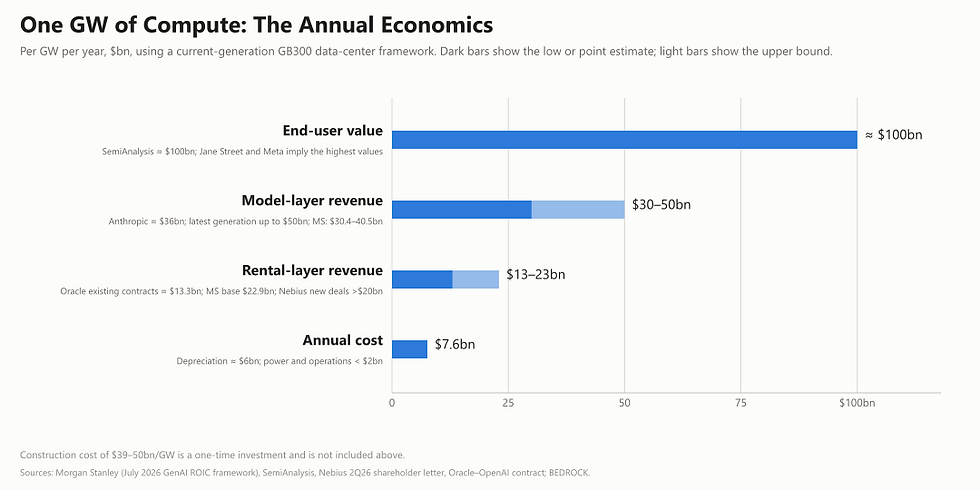
The most important line in this chart is the one at the top. One GW of compute creates roughly $100 billion of value for end users, while model companies currently capture only 30% to 50%; the rest remains with users. Dylan Patel’s words were that most of the value created by models has so far gone primarily to users. He cited Jane Street, which extracts far more value from tokens than Anthropic earns from it, and Meta, whose revenue from a few percentage points of additional engagement driven by advertising algorithms far exceeds its API bill. Dwarkesh Podcast
Customers buying software usually pay first for access and then turn it into results themselves. If AI can reliably complete a task, pricing can move closer to the outcome: how many customer problems were solved, how many accepted features were delivered, or how many transactions were completed. The most important shift is not the name of the pricing model, but which budget the customer uses to pay. A developer tool competes for software budgets; a completed software-development service competes for existing R&D and outsourcing budgets.
The transition has already begun. OpenAI’s Instant Checkout charges merchants when transactions are completed. OpenAI has not become a retailer, but it has begun earning revenue from transactions. Its CFO wrote in January that as AI enters scientific research, drug discovery, and financial modeling, “licensing, IP-based agreements, and outcome-based pricing will share in the value created.” Anthropic’s financial-services Agent templates launched in May cover concrete workflows such as customer-identity checks and month-end closing. Their users include institutions such as Citadel, BNY, and Carlyle, bringing the product closer to specific work and specific budgets. OpenAI Anthropic
“Sponsoring a new army” has also begun. In May, OpenAI led the creation of a deployment company funded with more than $4 billion from TPG, Advent, Bain Capital, Brookfield, and others. It acquired roughly 150 forward-deployed engineers from Tomoro to help enterprises put Agents into production. Anthropic, Blackstone, and Hellman & Friedman formed Ode with about $1.5 billion of committed capital. The structure is the same: implementation fees and revenue shares from the products built flow into the joint venture; token revenue continues to flow to the laboratory; and the laboratory contributes models, its brand, and part of the equity.
Nvidia is actually the company that most resembles the arsenal. It has been pursuing the same strategy one layer lower, and it started earlier. Beyond selling chips to a handful of hyperscalers, it supports a new group of GPU rental providers: investing in and placing orders with companies such as CoreWeave and Nebius, guaranteeing them a minimum rate of $2.12 per GPU hour—exactly the cost-recovery line of $7.6 billion per GW per year—and then taking 35% of the rental income above that level. The first section asked why Nvidia would put its own credit behind its customers. This is the answer: it no longer merely sells a chip once; it advances the army’s pay and then shares the spoils. Morgan Stanley estimates that if the more than 20 GW of new capacity in 2027 is contracted at $20 million per MW, it would create a GPU-rental revenue pool of roughly $500 billion, of which Nvidia could take about one-quarter. The arsenal has begun paying the new army in exchange for a share of its spoils.
Pricing power ultimately follows scarcity. Mid-tier intelligence will be commoditized by open-source models to one-tenth the price, while only frontier models can perform the hardest and most valuable work, allowing frontier pricing to move closer to end value. SemiAnalysis expects Anthropic’s blended monetization to rise from $50 million per MW to $70–80 million by the end of 2027. The benchmark for this form of monetization shifts from software and advertising to payroll: total US employee compensation was about $15.73 trillion in 2025. Capturing 1% would be $157 billion; capturing 10% would be $1.57 trillion.
Return to the question of how “tens of GW become trillions.” The two laboratories have signed commitments for roughly 45 GW. At today’s $36 billion per GW, that represents $1.6 trillion of model-layer revenue. If monetization moves toward end value, reaching $70–100 billion per GW, the same 45 GW would produce $3–4.5 trillion. Trillions do not require a miracle; they require model companies’ share of this economic ledger to rise from 30%, which is precisely what the static algorithm assumes will not happen.
The Third Option: Enter the Field Directly—AI Shifts from Intelligence Used by Others to an Agent That Uses Intelligence
Under the first two options, AI remains a tool; only the payment model changes from per-unit pricing to a share of the spoils. The third offers far greater room for imagination.

A new Thanos!? One snap could reorder not half the universe, but half an industry. Dario Amodei and the “country of geniuses in a data center” he describes. Image: The Information / Getty Images
We have traditionally assumed that OpenAI and Anthropic create intelligence and sell it to the world, after which enterprises must redesign processes and train employees before they can use it. As long as that step proceeds slowly, deep AI adoption remains constrained. But why must everyone first learn how to use it?
The companies with the best tools can also use those tools themselves. Instead of teaching customers one by one, they can complete the work and sell the result.
A small business may need to develop and maintain internal software, yet have no desire to study model selection and Agent orchestration, much less hire an AI team. If a service provider accepts the requirement and completes the development, deployment, and maintenance, the customer is buying a software service, not an AI class. The same logic applies to customer service, financial operations, marketing content, and parts of professional analysis. The difficulty does not disappear, but the party responsible for solving it changes. Instead of every customer exploring the problem separately, one provider can turn the data, workflows, and acceptance criteria into a reusable service.

Sequoia calls the gap in the middle the “application-layer opportunity.” We call it the part that has not yet been priced.
This chart from Sequoia Capital’s AI Ascent conference in April makes the situation clear: the capability curve has already turned sharply upward, while the adoption curve still rises only gradually. Sequoia calls the gap between them the “application-layer opportunity,” meaning that a group of application companies must translate capability into products and gradually teach each industry how to use them. Our view differs slightly: two forces will fill the gap at the same time. One is model companies entering the field themselves to complete the work; the other is competition, as early adopters defeat non-adopters and force the remaining companies to follow.
Consider competition first. New technologies have never spread by retraining people in old skills. Firearms did not prevail by persuading archers and knights. Mamluk cavalry regarded firearms as dishonorable weapons, and after being defeated by Ottoman muskets and cannons in two battles in 1516 and 1517, they lost Egypt. Tokugawa Japan restricted firearms for more than two centuries, until the Black Ships arrived. Opponents of firearms never claimed that they could not kill; they argued that firearms were dishonorable, uncontrollable, and destructive of the established order—the same category of objections heard today about AI hallucinations, safety, and compliance, and just as incapable of determining the outcome.
Firearms overwhelmed opponents through two advantages. A longbowman required ten years of training, while a musketeer could be fielded in weeks, turning a capability that once required a decade to develop into something supplied by quantity. This was paired with organizations built around volley fire and standing armies; an army that merely bought cannons but did not reorganize could still lose. Both principles apply to AI. Compute turns intelligence that once required ten years of training into something supplied by the GW, while an enterprise that buys Copilot seats without restructuring its workflow resembles the Beiyang Fleet after buying Krupp guns. This yields a testable prediction: the speed of AI penetration will be ordered by the intensity of competition in each industry, not by technical fit. Software, trading, e-commerce, and media—industries that fight daily—will move first. Law, healthcare, education, and government, protected by licensing walls, will move slowest, until their own Black Ships arrive.
Now consider the other force: the arsenal leads the army itself. Historically, arsenals almost never went this far; cannon makers did not command troops. One merchant did: the East India Company, a trading company that maintained an army of 260,000 by 1803—twice the size of the British Army at the time—and conquered all of India. The laboratories building this generation’s weapons are doing something similar, beginning inside the laboratories themselves. Dylan Patel estimates that laboratories use roughly 40% to 50% of their compute for external inference, about 10% to train the next released model, and all the rest for R&D, testing things that do not yet have names. These companies’ largest category of compute spending serves neither today’s customers nor the next product version. It searches for the next product and the next business model, so measuring it against current revenue is inherently impossible. Dylan has also observed laboratories shifting inference compute back into internal R&D because internal deployment creates more value than selling tokens externally.
Several companies have described how far internal automation has progressed. Dario said in February that end-to-end coding automation—from requirement to deployment without a human writing code—would arrive “within one or two years.” At Davos, he quoted his head of engineering: “I don’t write code anymore. I ask Opus to do it.” OpenAI’s GPT-6 Astra, released this week, autonomously found an unknown security vulnerability for the first time without continuous human intervention. Altman called it “the first model that is genuinely inventing something new at a meaningful level.” Fortune

Reported by Stephanie Palazzolo in The Information on September 4, 2026.
A smaller and more concrete example came in a September 4 report by The Information: Anthropic is developing in-house payments technology, potentially weakening the position of Stripe, its payments provider of many years. Job postings show that Anthropic is assessing which payments, billing, tax, and treasury systems to build internally. One role calls for “building production-grade financial applications that no vendor has built for us.” Mature companies commonly build parts of their finance stack as they grow, so that alone is not major news. What matters is the context: its business is “scaling faster than the processes and systems that support it,” and it happens to possess one of the strongest coding Agents. When the marginal cost of building a system internally falls sufficiently, the answer to “buy or build” changes. The first industries model companies touch by entering the field themselves may well be their own software suppliers. The Information
Model companies need not capture every city. A realistic approach is selective entry: software, digital operations, and verifiable professional services first. Further ahead, if a model company helps discover a drug or design a material, it need not build a pharmaceutical plant. It can work with industry partners and turn the result into licensing, milestone payments, or revenue sharing—returning to the second option. This logic has one prerequisite: frontier models must retain a clear advantage. If general-purpose models quickly become cheap and similar, the scarce assets will instead be industry data, customer relationships, and delivery experience, leaving more value with application companies. But as long as the prerequisite holds, we are valuing not a single product but a capability that can continuously enter new businesses.
Once AI becomes the party that uses intelligence, the economic benchmark shifts from payroll to incremental GDP. In “Machines of Loving Grace,” Dario estimates that after powerful AI becomes widespread, the economy could sustain annual GDP growth of 10% to 20%, compared with only 2% to 3% in developed economies today, powered by “a country of geniuses in a data center.”
The scale of that “country of geniuses” can be estimated. Dwarkesh Patel calculated that frontier compute grows four- to fivefold each year while the compute required to reach the same capability falls threefold. Multiplied together, the frontier laboratories’ “effective AI population” grows tenfold annually: OpenAI is equivalent to roughly 10 million AI workers this year, 100 million next year, and 1 billion the year after. Dylan’s corresponding estimate is that 1 GW of compute can support the work of roughly 1 million white-collar employees; at $100,000 of output per person, that equals $100 billion, which is the source of the end-value line in the economic ledger. This is a rough estimate and should not be treated literally as 1 billion employees, but it clarifies one point: these companies are not buying servers for existing customers; they are acquiring a workforce that does not yet have a name. The two companies’ commitments of roughly 45 GW correspond to the workload of tens of millions of white-collar workers. Measuring those purchases against today’s API revenue captures only the small portion of that workforce currently hired out.
As for the circulating claim that “only one private company will remain,” it was something investor Gavin Baker said he had heard on the All-In podcast. Anthropic researcher Sholto Douglas called it “completely false,” while Dario responded that “centralization versus decentralization” was a false dichotomy—although one cannot rule out that this may be Dario’s real view. We need not extrapolate to that extreme. Even if this logic applies only to a handful of high-value fields, it reaches far beyond the market for chat subscriptions or even Agents. Yahoo Finance
The picture becomes clearer when the timeline is extended across three centuries. At the same conference, Sequoia’s Konstantine Buhler showed two charts depicting who performs the “work done in service of humanity”: the first covered physical work, the second cognitive work.


In the first chart, humans and animals performed almost all work for more than a century after 1700. The steam engine took a hundred years to reach 20%. Around 1900, the internal-combustion engine was still a barely visible sliver in the upper-right corner; fifty years later it performed more than half the world’s work, and today it approaches 90%. In the second chart, electronic computation began taking a substantial share in 1950, while the thin sliver representing neural networks has only just appeared—roughly where the internal-combustion engine stood in 1900. Buhler argues that in the not-too-distant future, machines will perform 99.9% of cognitive work on Earth: “It will look much like the Industrial Revolution, only much larger and faster.”
The exact figures are debatable, but the direction is easy to understand. If the pattern in these two charts holds, the age in which AI rather than humans performs most cognitive work and produces most intelligence has only just begun. The tens of GW debated today are the first units of capacity in that tiny sliver. The charts also carry a warning: steam engines were once new, yet were eventually displaced by something newer. The steps will not stop at the feet of any one company.
Seen in this light, compute demand looks different. Compute can serve today’s customers, develop stronger models, or be deployed by model companies in businesses they operate themselves. For these companies, it is not merely the cost of serving customers but a means of production: whoever controls the most frontier compute controls the most “hands.” This also explains several facts that a static algorithm cannot.
First, why sign long-term contracts for more than 10 GW and build data centers instead of renting cloud capacity on demand like ordinary software companies? Morgan Stanley estimates a 25% after-tax profit margin for APIs run on rented compute, versus a 46% ROIC for APIs run on owned compute; only the rented-compute tier loses money when token prices fall. Anthropic’s lower-cost TPU and Trainium capacity and OpenAI’s Stargate both convert $10–20 billion of rent per GW into $7.6 billion of owned cost. Once compute becomes a means of production, no one wants to rent forever. Second, why contract for compute before the revenue arrives? Data centers take two to three years to build, so the compute contracted today determines the revenue ceiling two or three years from now. Third, why risk overinvestment? This is a winner-takes-most market: the cost of investing too little is elimination; the cost of investing too much is dilution or one ugly quarter. Dario’s reference to $1 trillion and bankruptcy describes the scale of that wager.
They are willing to spend so much because, in their economic ledger, compute is an army—not a cost.
IV. Who May Be Wrong, and What Should We Watch Next?
Return to the opening question. Wall Street is asking whether the visible businesses can pay today’s bills; the industry is betting that the work it can deliver in the future will extend far beyond today’s products. On direction, the static camp has already been wrong three times. If either of the latter two monetization paths is even partially realized, valuing chip, memory, and cloud-company earnings as a cyclical peak means mistaking a structural migration for an inventory cycle.
But Silicon Valley could also be wrong—at least in this cycle. The preceding discussion describes how the business could change after the next capability step arrives; it does not establish that the step will arrive on time. Investors lost in exactly this way during the last internet revolution. The destination was entirely correct: e-commerce, search advertising, and cloud computing all became trillion-dollar businesses. Yet in 2000, none of the mature models had arrived, while valuations already assumed the world after they had. Capital expenditure was justified by the claim that “internet traffic doubles every 100 days”; in reality, it doubled only once a year. By 2002, only a few percent of the fiber installed under that assumption had been lit. More than $10 billion of vendor financing from Lucent and Nortel became their own bad debt when customers failed.
Every element has a counterpart today: capacity scheduled on the assumption that eightyfold annual growth is normal; Nvidia’s rental-rate guarantees to GPU providers and its $105 billion of financing for OpenAI; and tens of GW due to come online together in 2027 and 2028. The first section described TSMC and Broadcom as the companies least like gamblers, but one qualification is necessary: they see customer orders, and those orders are scheduled by extrapolating eightyfold growth. Corning and Nortel also saw orders in 2000.
What would stagnation look like? There are two possibilities. The first is that Agents fail to achieve broad adoption. In “AI Adoption Is Broad, but Deep Use Is Still at 1%,” we noted that Ramp’s billing data shows the median company spends only about $12 per employee per month, while the top 1% spends $7,400. If that 1% is still 1% three years from now, the gap between the capability and adoption curves will remain unfilled, while the third monetization path has not yet reached scale; compute will arrive before demand. The second possibility is that no major new demand emerges after coding and Agents: reinforcement learning remains confined to coding, law, finance, and customer service remain pilots, and monthly additions stay at the $9 billion level for two years.
Both paths end in the same place: an investment-cycle mismatch and oversupply. Capacity coming online in 2027 and 2028 is financed by debt, leases, and vendor guarantees. If monetization per GW falls rather than rises when that capacity arrives, rental rates will first drop below the guaranteed floor, then pressure the credit of Oracle and GPU rental providers, and finally reach Broadcom’s $350 billion shipment guidance, which is based on its customers’ plans. The fall in H100 rental rates from $8 per hour in 2023 to $2 by the end of 2024 was a small-scale preview. This cycle differs from 2000 because utilization is full, supply is constrained, fiber can operate for twenty years, and GPUs depreciate fully within five, allowing excess capacity to clear itself. Thus, even a stall would more likely produce a sharp two- or three-year downturn than a decade-long winter. But for a supply chain priced on peak-cycle earnings, two or three years is painful enough. Latent Space
There is no conclusion today, nor should there be. The most honest answer to “who is wrong?” is that the industry is probably right about the destination, while Wall Street may be right about the path—and an error along the path can be enough to eliminate the first round of financiers, as happened with railways and fiber. Starting from current valuations, the odds are asymmetric: path risk is already embedded in forward multiples of 10 to 15 times, while the destination’s potential is not. But favorable odds are not certainty. This is also how we approach the supply chain: the destination determines direction; the path determines position sizing.
The signals to watch are therefore shifts in gear. Level measures such as revenue and valuation multiples cannot tell us where the next step lies. There are seven specific lights: four pointing upward and three downward.
The four upward lights. First, the second monetization path begins and pricing changes: outcome-based pricing appears at scale; OpenAI’s transaction fees, licensing, and intellectual-property agreements enter reported financials; and model-company monetization per GW rises from $36 billion toward more than $50 billion. Second, the third path begins and model companies truly enter the field: the 40% to 50% of compute devoted to R&D produces a new product or business that is not merely a “new version,” and “buy or build” decisions such as Anthropic’s in-house payments effort appear in volume. Third, competition begins to replace training: for the first time, companies in an industry that do not use AI visibly lose share and are forced to follow, determining whether 1% becomes 10%. Fourth, capability reaches another level: a second industry beyond coding closes the reinforcement-learning loop and begins contributing revenue, while Astra-level models continue producing verifiably new discoveries.
The three downward lights. First, Anthropic’s monthly additions remain stalled for another two quarters and no new product form appears. Second, monetization per GW declines as capacity comes online, GPU rental prices fall below Nvidia’s guaranteed level, and newly signed contracts at companies such as Nebius carry lower unit prices. Third, vendor financing continues to rise while customer cash flow fails to keep pace, and credit spreads widen for Oracle and GPU rental providers—the signal that flashed first in 2000.
Wall Street asks why selling chat tools and Agents could require so much compute. Perhaps it should ask one step further: if these companies ultimately do more than help the world use intelligence—if they begin using intelligence to conduct business themselves—are we even calculating the market they are preparing to enter?
The Destination Is Probably Right—but Could the Path Be Wrong?
This discussion presents an industry and scenario framework only and does not constitute investment advice. Data are current as of September 5, 2026. Company-reported annualized revenue, compute capacity, valuation multiples, and forward guidance may change; comparisons across reporting bases are used only to assess orders of magnitude.


Comments