
From Manual Execution and Process Checks to Systems That Run the Workflow

Updated: Sep 9

The most expensive part of middle- and back-office work is often not entering information once, but requiring a key person to assess every document from scratch: What is it? Where should it be updated? What must not be disclosed externally? Who is accountable for the result?
Meeting minutes, NAV schedules, subscription and redemption files, valuation sheets, contracts, and product materials keep arriving. In the past, people had to connect nearly every step—collection, classification, updating, checking, and tracking—and repeat the same kinds of work again and again.
With AI, we began building a system. AI does more than help process one document. We use it to connect filing, assessment, proposed updates, review, and publication into one system-driven chain, then let the system operate automatically under defined rules. Reliability comes not from unconstrained generation, but from sources, rules, automated validation, human confirmation, and feedback from corrections. People no longer carry repetitive work from one step to the next; they focus on boundaries, exceptions, and final approval.
When a document arrives, a key person used to take over; now the system goes first
Before: A person receives the document → classifies it → updates multiple repositories → checks and tracks it | Now: The system collects and files it → evaluates it → automatically generates proposed updates → a person reviews and provides feedback
Here, DDQ refers to the due diligence questionnaire repository, CRM to the client communication and follow-up repository, and FAQ to the frequently asked questions repository. The operational ledgers contain confirmed data such as NAV, subscriptions and redemptions, and valuations. These repositories used to be fragmented; a unified control layer now connects documents, sources, processing status, and review records.
Small firms did not lack the need; they lacked a practical way to build it
For a small firm, the problem is not merely that manual work is slow. In the past, a controlled workflow like this often was not built at all: it was too complex and too unlike a task that could be handed to a general operations team.
Buy a system | This requires licenses, integrations, data governance, permissions, and administrators. The investment is substantial and is rarely a small team's first priority.Build it manually | This requires a responsible lead who understands the business, clients, data, and compliance. Even when such a person exists, their time is better reserved for more important judgments.Make do with simple tools | The result is often a few Excel files, scattered documents, and a small amount of institutional memory: usable, but rough, difficult to trace, and hard to scale reliably.
What AI changes is feasibility. It does not eliminate workflow design or expert judgment. Instead, it concentrates high-level expertise in the initial codification of rules; the system then executes repetitive steps, while general operations staff perform standardized reviews. This allows a small team to start with a controlled proposed-update workflow rather than choose between buying an expensive system and relying on a rough manual workaround.
One anonymized closed loop: How 4 sets of meeting materials become publishable updates
In one real closed loop, 4 sets of meeting minutes and transcripts entered the system. The system first completed filing and evidence registration, then identified client questions, reusable language, and sensitive content.
01 | File | Record the original file, date, source, permissions, and version.02 | Route | Client follow-ups become proposed CRM updates; general language suitable for external use becomes proposed FAQ updates.03 | Block | Sensitive details—including positions, companies, trades, and model figures—do not enter the general FAQ or Shared repository.04 | Review and publish | Generate a proposed copy in a real Excel file. Only after a person reviews the boundaries and results does the system publish automatically.
Important boundary: Meeting materials may update client communications and FAQs, but they must not directly change live operational ledgers. Formal data such as NAV, subscriptions and redemptions, and valuations must come from explicitly designated official sources.
Another closed loop: How product valuation sheets and subscription/redemption records automatically update operational ledgers
This workflow handles formal operational data rather than client communications. When product valuation sheets and subscription/redemption records arrive, the system does not overwrite the official ledgers. It first generates proposed updates for review.
01 | Identify official sources | File product valuation sheets and subscription/redemption records, recording the product, date, source file, and version.02 | Update and analyze automatically | By client, update subscriptions and redemptions and calculate profit/loss and returns; by product, update subscriptions and redemptions, NAV, and assets, and generate periodic visual analysis.03 | Write to a proposed ledger | Automatically write updates into a proposed copy of the native Excel workbook, retaining a link to the source and version for every item.04 | Validate, confirm, and publish | The system checks fields, sources, periods, and export consistency. It publishes automatically only after the operations team confirms the proposed result. Exceptions return to the control layer for review.
Automation boundary: Automation updates a proposed ledger; it does not bypass review and directly alter official data. Only valuation sheets and subscription/redemption records defined as official sources may enter this workflow. Meeting minutes, oral discussions, and unconfirmed materials are kept out.
The system is not handling a one-off task; it is a controlled update workflow designed to run repeatedly
The objective is not to have AI help with one particular task. It is to codify a validated, correct method into a system that can execute it repeatedly. Once the system is in place, the next set of meeting minutes, valuation sheet, or subscription/redemption record follows the same rules for sources, routing, proposed updates, validation, review, and rollback automatically.
This moves the middle and back office from having people reprocess every case to having the system continuously process similar tasks. Content updates and data updates follow separate paths, then converge at the post-update check. If a problem appears, the item returns to the control layer; after the correction, the next similar document can move through the workflow more reliably.
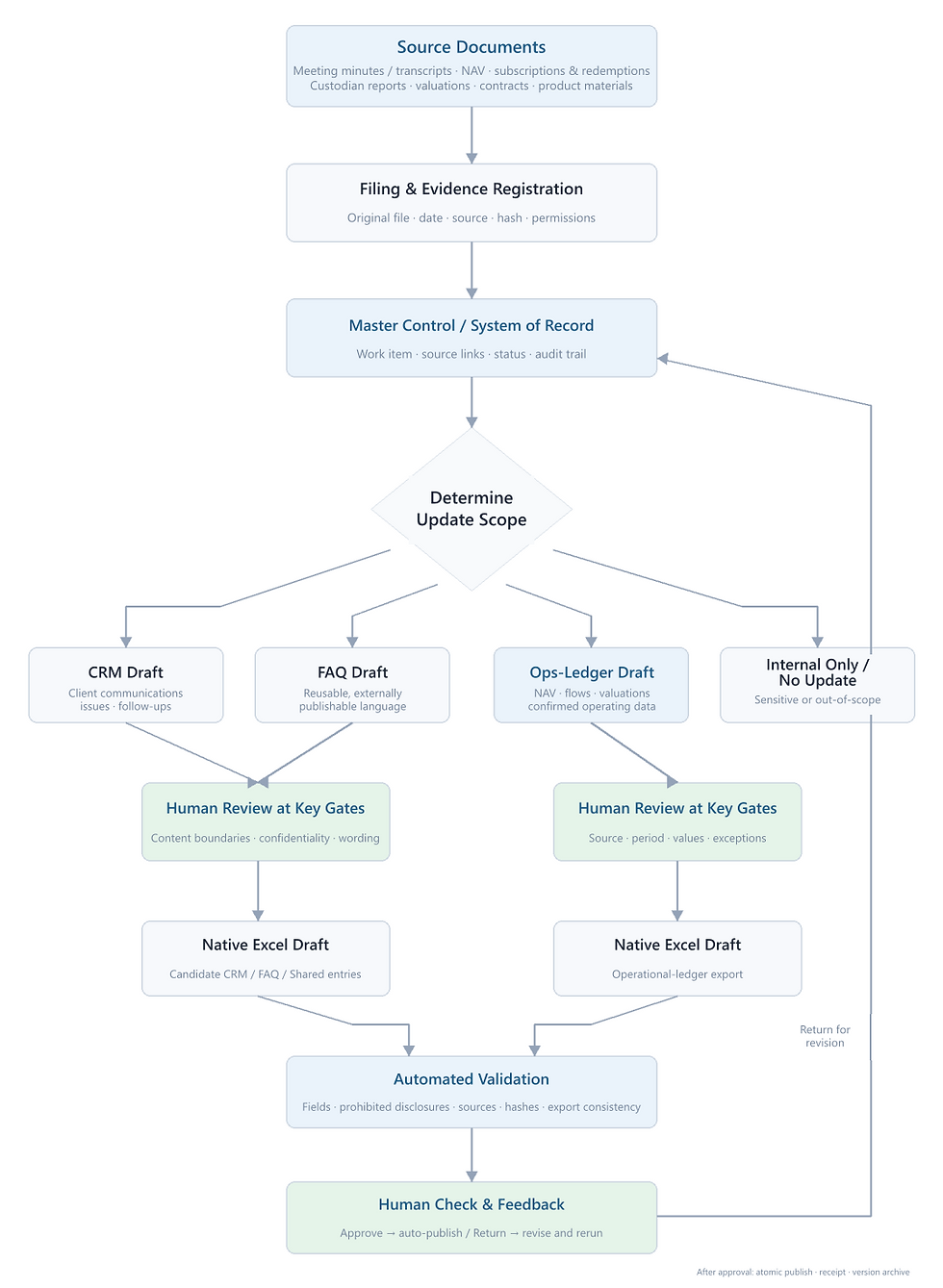
Unified control workflow: Rather than processing an item once, every similar document continuously follows the same rules for intake, routing, proposed updates, validation, review, and publication.
People do not disappear; they step back from repetitive operations to the critical control points
The build phase still requires senior owner-level expertise: defining what qualifies as an official source, what may be shared externally, what must be blocked, and how exceptions should be handled. These judgments are what the system ultimately codifies.
Once the system is stable, the firm's most senior leaders no longer need to handle every batch of materials personally. General operations staff can review proposed results, report issues, and handle standard exceptions. Only new rules, material exceptions, or high-risk publications are escalated to experts.

High-level expertise is front-loaded in the build phase. Once stable, standardized operations can handle routine maintenance, with experts brought in for exceptions. The planning model assumes 20 routine batches per week.
Reliability comes from rules, validation, and corrective feedback—not from letting the model ‘train itself’
Every review can codify boundaries as source rules, field rules, and nondisclosure rules. When the next similar document arrives, the system follows those rules; people need to examine only new exceptions.

Reliable automation: A person makes a judgment, the judgment is codified as a rule, the system executes it, and a person reviews the result and can return it for correction.
This is not one grand blueprint; it is a sequence of 4 incremental upgrades
The system began with the DDQ repository in early July, first addressing what to answer and where to enter it. It then captured client questions and approved external language, established official data sources for the ledgers, and finally connected document intake, updating, review, and publication to the same control layer.

From DDQ to CRM/FAQ, operational ledgers, and unified control: Each business problem solved hands another category of repetitive work to the system.
AI is not free, but it reduces the repetitive work done by key people
During the build phase, costs are concentrated in codifying rules, validating long documents, and making repeated corrections. Once the system is stable, the main costs are model usage, rule maintenance, and limited human review. These can be tracked by task and optimized by exception, without requiring scarce senior owners to participate in every operation.

Only actual Token usage related to middle-office operations is included; investment-research usage is excluded. The 2 reports cover different periods and scopes and must not be added together as the total cost of a single project.
Start with one proposed-update workflow, not a one-time rebuild of every system
The best starting point is not to buy a large system first, but to select one high-frequency, repetitive, reviewable workflow—for example, meeting minutes to CRM/FAQ, or NAV and subscriptions/redemptions to an operational ledger. First achieve ‘automatically generate a proposed copy + publish after human approval,’ then gradually expand the types of materials and rules covered.


Comments